How to Split Rent With Roommates Fairly (4 Methods Compared)
Four ways to split rent with roommates — equal, by room size, by income, and bidding — with worked examples and the rules that keep it from becoming an argument.
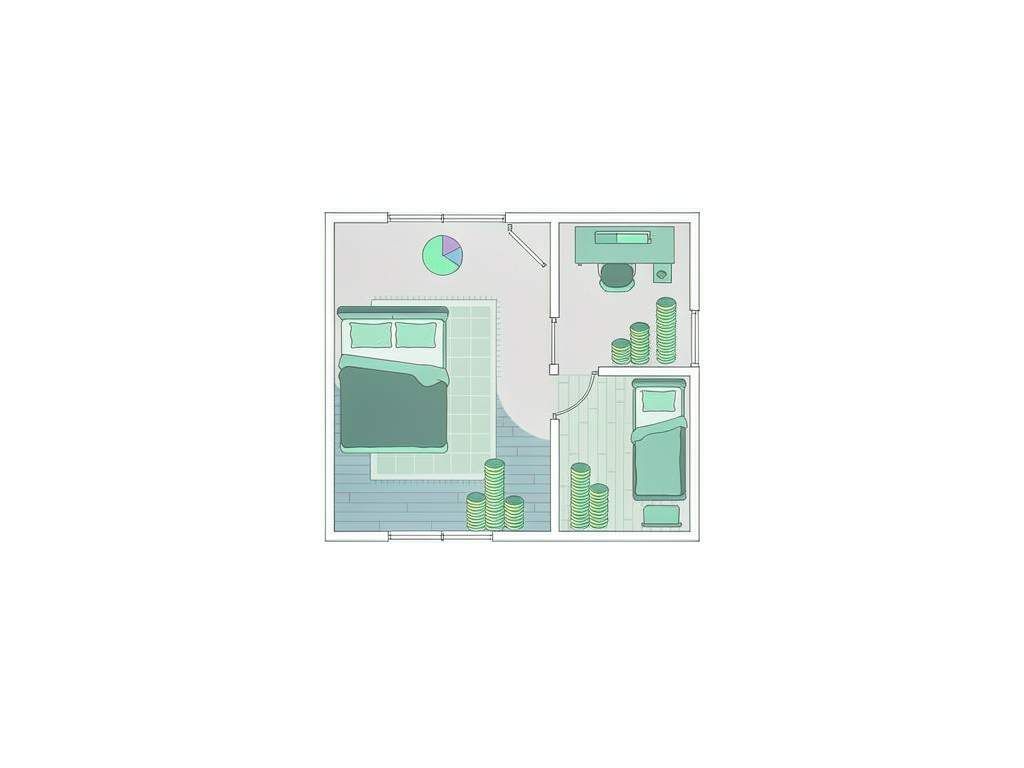
Few things test a friendship like a rent bill. Split evenly, the person in the windowless box pays too much. Split by room, someone insists their closet “doesn’t count.” Here are the four methods people actually use, what each is good for, and how to run one without a fight.
Method 1: Split evenly
Everyone pays the same share. For a $2,400 three-bedroom with three people:
$2,400 ÷ 3 = $800 each.
- Good for: identical rooms, similar incomes, or groups that value simplicity above all.
- Fails when: rooms differ in size, light, or private-bathroom access. The person in the worst room is subsidizing the best one, and they know it.
This is the right default only when the rooms genuinely are interchangeable.
Method 2: Split by room value
Each room gets priced by its advantages: square footage, private bath, natural light, closet space, noise. Add a premium to the good rooms and a discount to the bad ones, with all premiums and discounts summing to zero.
A common practical approach:
- Price the common space as a shared base (say 40% of rent).
- Split the remaining 60% across rooms by size, then adjust for extras.
Example — $2,400, three rooms, 40% common base ($960 ÷ 3 = $320 each):
| Room | Size share | Adjustments | Room total | Per person |
|---|---|---|---|---|
| Master + bath | $672 (35%) | +$120 | $992 | $992 |
| Medium | $480 (25%) | −$40 | $760 | $760 |
| Small | $288 (15%) | −$80 | $208 | $208 |
Wait — check the math: $320 + $672 − $120… the cleanest way is: total of the three room shares must equal $1,440 (60% of rent), and adjustments must net to zero. Our calculator does this arithmetic for you, including utilities on top.
- Good for: the most common real-world situation — unequal rooms, people who care about fairness.
- Fails when: people can’t agree on what a private bath is worth. (Spoiler: use a number and move on. Perfect pricing doesn’t exist.)
Method 3: Split by income
Each person pays proportional to what they earn. If three roommates make $45k, $75k, and $120k:
-
Total income: $240k
-
Shares: 18.75% / 31.25% / 50%
-
On $2,400: $450 / $750 / $1,200
-
Good for: couples with big income gaps, close friends who see the apartment as a shared project, situations where the lowest earner is doing unpaid work (like handling all groceries).
-
Fails when: the arrangement is with acquaintances, or when it breeds resentment over lifestyle differences. Income splits can quietly become “why does he get to order takeout if he can’t afford rent?”
Method 4: Room bidding (the auction)
Everyone writes down what they’d pay for each room, in secret. Highest total bidder gets the best room; the other rooms are assigned by bid order. The beauty: the market decides, and nobody can blame you for the price they themselves offered.
- Good for: competitive groups, repeated disputes, or when one room is obviously better and fighting over it is inevitable.
- Fails when: people bid strategically low (rare) or someone later regrets their bid (common — but they set it).
Whichever method: write the rules down
Most rent disputes aren’t about the split method — they’re about the stuff nobody agreed on in advance:
- Utilities: split evenly regardless of rent method, or fold them into each person’s share from day one.
- New roommates: renegotiate the split whenever someone moves in or out — old shares die with the old lineup.
- The master bedroom premium: decide before viewing the apartment, not after. “We’ll figure it out later” is how arguments start.
- Short stays: guests who stay over half the week are effectively roommates; agree on how that affects bills.
Run the numbers
Pick a method and let the calculator handle the arithmetic — equal, income-based, or room-value weighting, with utilities split separately:
If the rooms themselves are the disagreement, measure them: the Square Footage Calculator computes room areas (including L-shaped layouts) so the size-based split starts from facts, not feelings.